A face can look a little fuller after moisturizing and still look different from how it did ten years ago. Both observations can be true. They describe changes happening at different depths, on different timescales.
“Bounce” is a useful everyday word, but it bundles several things together: how skin feels when it moves, how hydrated its surface looks, and how the tissues beneath it support the face. To understand what skincare research is measuring, it helps to unbundle them.
Meet the structure beneath the surface
Below the epidermis sits the dermis, a layer of connective tissue. Much of its support comes from the extracellular matrix, or ECM. “Extracellular” simply means outside the cells; “matrix” refers to the surrounding network of materials.
This network gives cells something to attach to and helps determine how the tissue handles force. It is an active environment, continually maintained and altered, rather than a fixed cushion that gradually runs empty.
Collagen contributes tensile strength: it helps tissue resist being pulled apart. Elastin, organized within elastic fibers, helps tissue recoil after stretching. Hyaluronic acid, or HA, is a water-binding molecule found in the spaces around cells. It belongs to a family called glycosaminoglycans—long sugar-based molecules involved in the tissue's hydrated environment.
These are different jobs. Adding more of one component cannot automatically recreate the arrangement and performance of all the others.
| Component | The job to remember | The misleading shortcut |
|---|---|---|
| Collagen fibers | Strength and structural support | More collagen always means better skin |
| Elastic fibers | Stretch and recoil | Every change in firmness is an elastin change |
| Hyaluronic acid and related molecules | A hydrated environment around cells | Topical hydration equals replacing lost facial volume |
| Fibroblasts | Making and maintaining much of the matrix | Cells just need to be switched “on” |
The maintenance cells respond to their surroundings
Fibroblasts are cells that produce and maintain many components of the dermal matrix. They also respond to physical signals from that matrix, including the tension created by their attachments.
A practical comparison is a person working on uneven flooring. Their ability to do a job depends partly on the condition of the surface supporting them. Cells are not people, of course, but their surroundings can influence how they behave.
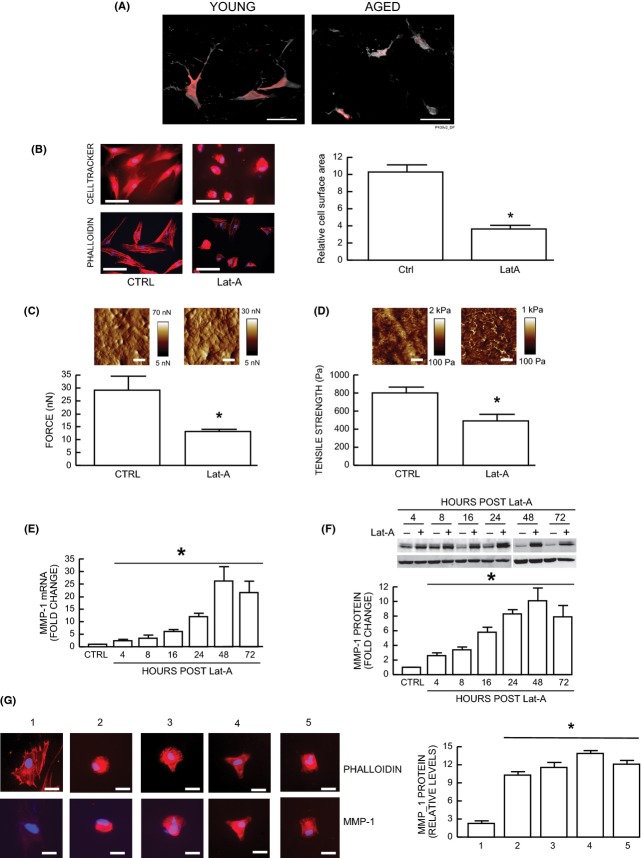
In a study comparing younger and older human skin, researchers found evidence that reduced collagen production involved both changes in fibroblasts themselves and changes in their mechanical relationship with the surrounding tissue. The work included tissue analysis and cells studied outside the body.
That is why “stimulates collagen” tells only part of the story. A result involving one signal in isolated cells does not tell us whether a treatment creates well-organized, durable support in a person's skin.
Collagen has a lifecycle
Your skin both makes collagen and breaks it down. Some breakdown is part of normal tissue maintenance. Problems arise when the balance, organization, or quality of that remodeling changes.
One relevant enzyme is matrix metalloproteinase-1, or MMP-1. An enzyme helps a chemical reaction occur; this one can begin cutting certain collagen fibers. The memorable version is that skin has tools for dismantling old structural material as well as tools for building it.
A 2009 study of human skin and laboratory models linked fragmented collagen with reduced fibroblast stretching and greater oxidative stress. Cells in fragmented collagen also increased MMP-1 expression. The authors proposed a reinforcing cycle in which a damaged environment makes further damage more likely.
This helps explain why skin aging cannot be reduced to one missing ingredient. The arrangement of the material and the behavior of the cells living in it both matter.
The quick improvement can still be real
If fine lines look less obvious when your skin is well moisturized, there is no need to dismiss the change. Surface hydration is a meaningful benefit. The question is what you can reasonably conclude from it.
In a 60-day trial involving 76 women, researchers compared several hyaluronic-acid formulations with a control cream around the eyes. They measured improvements in hydration and elasticity; some formulations also improved wrinkle-depth measurements.
The study did not show that a topical application replaced lost facial fat or rebuilt an entire dermal framework. A measured change in skin's mechanical response can reflect several contributing factors. That makes “elasticity improved” more precise than “the skin regenerated.”
The distinction is especially useful when you see a rapid result. Ask whether the change was measured immediately, during continued use, or after treatment stopped. Those timelines answer different questions about how lasting the effect might be.
A face is more than its skin
Changes in facial contours cannot all be assigned to collagen in the dermis. The tissues beneath the skin also contribute to facial shape. A photograph showing a different jawline does not isolate which layer changed—and differences in expression, head position, lighting, and camera distance can change what you think you see.
For your own comparisons, use similar light and a relaxed expression. Look for the particular outcome you care about, rather than treating every “after” photograph as evidence of the same biological event.
If you are reading a study, check whether the endpoint was a participant's impression, a surface measurement, a biopsy, or a molecular signal. Each can be informative. None is interchangeable with the others.
Skin's bounce comes from a functioning system. Supporting comfort and protecting skin from repeated damage are worthwhile even when they do not produce a dramatic transformation. Understanding the system gives you permission to appreciate a modest, well-supported benefit without asking it to explain every change in your face.