
Peptides are often described as messages for your skin: signals that tell it to make more collagen, behave more youthfully, or soften expression lines. That is an appealing explanation. It gives a small ingredient a very specific job.
It also leaves out several steps. A proposed message needs the right structure, a route to the relevant location, and evidence that it changes something useful when it gets there.
Understanding those steps makes peptide science easier to follow without treating all peptides as interchangeable—or assuming the whole category is hype.
A peptide is a short chain with a particular sequence
Amino acids are building blocks used to make proteins. A peptide is a relatively short chain of amino acids joined together. Different sequences produce different molecules, with different shapes and potential biological activities.
The order matters. The same letters can form different words; the same amino acids, arranged differently, need not communicate the same signal. This is a helpful starting analogy, although molecules also depend on three-dimensional structure and their environment.
You may see prefixes that describe the number of amino acids: tri- means three, penta- means five, and hexa- means six. Those names tell you something about length. They do not rank effectiveness.
Other parts of a name can indicate chemical modifications. Palmitoyl, for example, indicates the attachment of a fatty-acid-derived group. Such changes can affect a molecule's properties. They are not, by themselves, proof of delivery or benefit in a finished formulation.
Different peptides are studied for different jobs
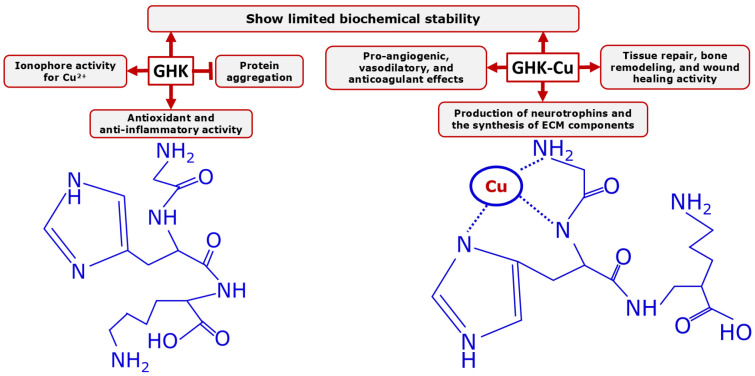
One research direction involves signaling peptides: molecules investigated for their ability to influence processes such as matrix production. Another involves peptide complexes that bind a metal, such as copper. Some peptides are studied for effects on aspects of cell-to-cell or neuromuscular signaling.
These are proposed functions, not guaranteed outcomes attached to every member of a category.
In an early fibroblast-culture experiment, a copper-binding tripeptide called GHK-Cu increased collagen synthesis under the tested conditions. The researchers exposed cells directly to the compound. They did not show that an ordinary topical application reached the same cells in human skin or produced the same result.
That distinction is central. Cells in a dish do not have an intact skin barrier sitting between them and the substance being tested.
The delivery question is part of the science
Your stratum corneum, the outermost skin layer, helps regulate what passes through. That is beneficial protection. It also makes delivering molecules to a deeper target a real formulation challenge.
An in vitro study takes place outside a living organism. Ex vivo work uses tissue removed from an organism. Both can be useful for studying skin penetration, provided their limits are clear.
In a penetration study using excised human and animal skin, researchers tested an acetyl hexapeptide-8 formulation for 24 hours. Most of the applied peptide remained at the surface; small amounts were measured in outer layers. None was detected in the dermis or the collection fluid beneath the skin.
“Not detected” means below what that method detected in those conditions. The finding does not prove that every peptide formulation fails to penetrate. It does show why a proposed deep target needs delivery evidence, rather than an assumption based on the ingredient's name.
It also makes comparisons with injected treatments unreliable. Applying a molecule to intact skin and placing a treatment beneath that barrier are different routes, with different exposure and evidence requirements.
There is some controlled human evidence
A 12-week trial of palmitoyl pentapeptide enrolled 93 women aged 35–55. Each participant used a moisturizer containing the peptide on one side of the face and the same moisturizer without it on the other. The study was randomized and double-blind, and the authors reported better wrinkle and fine-line measurements with the peptide-containing formulation.
Split-face means a person's two sides are compared, which helps reduce differences between participants. Double-blind means treatment assignments are concealed from both participants and relevant evaluators. A vehicle control helps separate the investigated ingredient's contribution from the base formulation's effects.
The study provides evidence for that formulation in that population over that period. It was conducted by researchers affiliated with a consumer-goods company, so independent replication is useful. It does not establish that every peptide has the same effect, or that a greater number of peptides produces a greater benefit.
Read the whole chain of evidence
| Question | Why it matters |
|---|---|
| Which exact peptide was studied? | Results from one sequence do not transfer automatically to another. |
| How was it delivered? | Direct contact with cultured cells differs from application to intact skin. |
| What was the comparison? | A moisturizing base can itself improve skin's appearance. |
| What changed? | A collagen-related signal, a wrinkle measurement, and a personal impression are different endpoints. |
| Who took part, and for how long? | A short study in one population leaves questions about other users and longer-term results. |
This is more informative than comparing impressive ingredient counts. A formula with several peptides could be useful, but the number does not tell you which ingredient contributed what, whether the combination was tested, or how much benefit to expect.
Give a specific benefit a specific name
If a study reports smoother-looking fine lines, that is a reasonable benefit to discuss. It does not need to become “reprogrammed skin” to be worthwhile. If it reports a change in cultured cells, it is better understood as a research clue than a finished promise.
You can be interested in peptides and still ask for the missing steps. In fact, those questions are how an interesting mechanism becomes a credible result. The most helpful answer is not simply that peptides “send signals,” but which signal, delivered where, with what demonstrated effect.