Most of us have a clear idea of what too much sun looks like: hot, tender skin after a day outside. The effects that develop slowly are harder to connect with any particular afternoon.
That gap matters. A skin change does not have to arrive with a burn to be related to ultraviolet exposure. And visible aging does not tell you whether you have been “good” or “bad” at skincare. It reflects biology, time, and a history of exposures that no one controls perfectly.
Understanding photoaging—skin changes associated with repeated light exposure—helps explain why everyday protection belongs in the conversation alongside treatment.
UVA and UVB are different parts of the same problem
Ultraviolet radiation, or UV, is energy from the sun at wavelengths shorter than visible light. The two categories most relevant to everyday sun protection are UVA and UVB.
UVB is strongly associated with sunburn. UVA penetrates more deeply into skin and contributes to photoaging. Both can damage skin; the familiar shorthand “UVB burns, UVA ages” should not be taken as a strict separation of their effects.
SPF, or sun protection factor, primarily describes protection against sunburn-producing UV. Broad spectrum indicates protection against both UVA and UVB. The American Academy of Dermatology explains these label distinctions, including why a higher SPF does not remove the need for shade, clothing, or reapplication.
For a reader trying to remember just one thing: the number and the words “broad spectrum” answer different questions.
How light reaches the collagen conversation
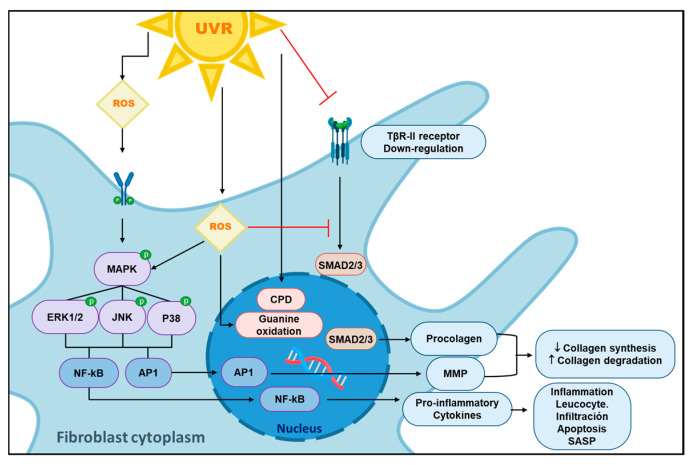
UV exposure can change cell signaling and increase the activity of enzymes involved in breaking down the extracellular matrix, the network surrounding cells in the dermis.
One family is called matrix metalloproteinases, or MMPs. These enzymes help cut and remodel structural proteins. Normal remodeling is necessary; repeated increases in breakdown can contribute to a less orderly support network.
In a human UV-exposure study published in 1997, researchers observed increased expression of several MMPs and increased collagen breakdown in exposed skin. Repeated exposures kept enzyme activity elevated. The experiments involved controlled exposure and skin sampling, largely in light-skinned adults; they were not a calculation of exactly what happens during every person's commute.
The useful idea is a sequence: exposure changes signals, signals affect tissue maintenance, and repeated changes can accumulate. That is more informative than imagining sunlight simply “melting” collagen.
A burn and a long-term skin change are different endpoints
Erythema means redness caused by increased blood flow near the skin's surface. It is often used as an endpoint in sun-exposure research. Photoaging may be assessed using changes in texture, lines, or pigmentation over a much longer period.
A treatment that reduces redness in a short laboratory experiment has not necessarily been shown to prevent years of visible aging. Equally, a useful long-term prevention study does not promise that existing lines will disappear.
| What a study measures | What it can help establish | What still needs separate evidence |
|---|---|---|
| Redness after controlled UV exposure | A short-term response to a defined dose | Long-term changes in facial appearance |
| A molecular marker in a biopsy | An effect on a specific biological process | A noticeable benefit in daily life |
| Surface texture over several years | Change over time under the study's conditions | Reversal of every existing sign of aging |
These distinctions are useful because “sun damage” can otherwise mean several different things in the same conversation.
The long-term prevention evidence is worth knowing
A randomized Australian trial involving 903 adults under 55 compared daily sunscreen use with discretionary use over 4.5 years. Researchers assessed skin-surface changes using graders who did not know the participants' assigned groups.
The daily-use group had lower odds of progression in measured skin aging: a relative odds estimate of 0.76, often reported as a 24% reduction. That is a group-level result for a particular measurement. It does not mean participants looked 24% younger or had 24% fewer wrinkles.
The distinction makes the finding more useful, not less. It is evidence that a repeated everyday habit can affect an outcome over years. It also sets a realistic expectation: protection works cumulatively, without needing to produce a new face by next week.
Pigmentation deserves its own attention
Skin tone changes how some effects of light appear, and sunburn is not the only outcome worth considering. In a study of 20 volunteers with skin types IV–VI, controlled exposure to visible light produced darker, more persistent pigmentation than UVA1 under the study's conditions.
Visible light is the part of the spectrum we can see. This experiment helps explain why pigmentation concerns may require a conversation beyond UVB and SPF. It does not establish that ordinary phone-screen use produces the same exposure or result as the study's light source.
If persistent pigmentation is your main concern, identify that concern specifically when seeking advice. “I want fewer dark patches” is a different goal from “I rarely get sunburned.”
Build protection around your actual day
The AAD recommends broad-spectrum, water-resistant SPF 30 or higher on exposed skin, alongside shade and protective clothing. When outdoors, reapply approximately every two hours and after swimming or sweating according to the directions.
Practical consistency matters. A hat by the door, a shaded place to sit, and protection that fits the activity are easier to maintain than an abstract promise to avoid every ray of sunlight.
You can enjoy being outside and take photoaging seriously. The goal is to reduce repeated exposure where you reasonably can, while remembering that skin changes with age even when you care for it well.