“Antioxidant” sounds reassuring even when the explanation stops there. It suggests protection, something happening quietly in the background, and perhaps a little insurance against everything your skin meets during the day.
But it describes a type of chemical activity, not a guaranteed result. To understand what antioxidants can do for skin, start with the problem they are intended to influence—and then follow the evidence from a laboratory reaction to an actual person.
What oxidative stress means
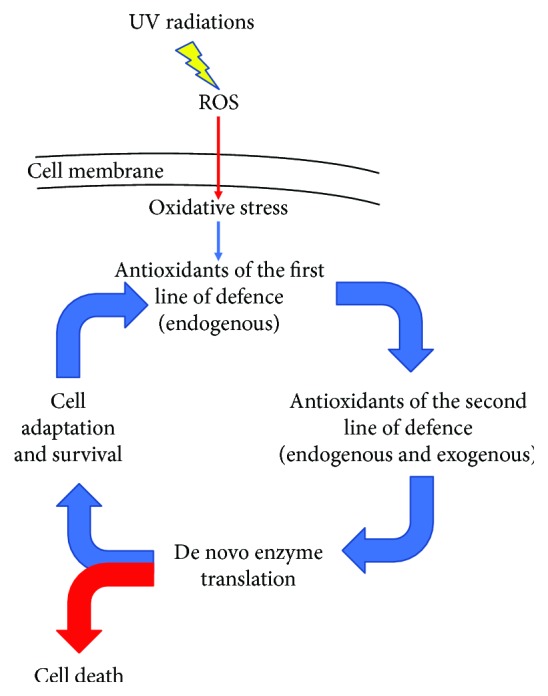
Oxidation involves the loss of electrons during a chemical reaction. A free radical has an unpaired electron, which can make it reactive. You will also encounter reactive oxygen species, or ROS: a broader group of oxygen-containing reactive molecules that includes some free radicals and some molecules that are not radicals.
The practical version is that certain molecules can react with nearby biological material. Skin has systems for managing these reactions. Oxidative stress describes a situation in which oxidant activity exceeds the capacity of those protective systems and can disrupt normal function.
The important word is “balance.” Reactive molecules also participate in normal signaling. The scientific goal is not to remove every reactive molecule from living skin, and “more antioxidant activity” is not automatically a better biological outcome.
How this connects to skin structure
Oxidative stress is often discussed alongside UV exposure and changes in the dermal support network. It can also be connected with the condition of the tissue surrounding cells.
In research on aged human skin and collagen models, fibroblasts in fragmented collagen showed increased oxidant levels and greater expression of a collagen-degrading enzyme. An antioxidant used in the cell model reduced that enzyme's expression.
That is evidence about a biological mechanism under experimental conditions. It does not establish that every topical antioxidant reaches those cells, works at the same concentration, or produces a visible improvement. The point is to identify a plausible target for investigation, not to turn the word “antioxidant” into a universal treatment claim.
A test-tube result is the first question
An assay is a test designed to measure a particular property. A chemical antioxidant assay might measure how effectively a substance reacts with a selected radical in a controlled solution.
This can help researchers compare materials. It leaves many questions unanswered: is the substance stable in its final formulation? Does it reach a relevant skin layer? Is the concentration tolerated? Does the proposed reaction happen there? Is the resulting change meaningful to a person?
Think of it as testing a key before you know which door it will need to open. A promising test result is useful, but the conditions of use still matter.
Bioavailability describes how much of a substance becomes available at the place where it needs to act. For a topical application, the intended location matters: an effect at the surface does not require the same delivery as an effect in the dermis.
Delivery can change the answer
One percutaneous absorption study examined L-ascorbic acid, a form of vitamin C, in pig skin. “Percutaneous” means through the skin. The researchers found that delivery depended strongly on formulation conditions, including acidity and concentration.
This is a helpful example of why an ingredient name is insufficient. It is also an animal-model experiment, not a prescription for choosing the strongest or most acidic option available. Its results cannot be extended automatically to every vitamin C derivative or every human face.
Stability is another part of the question: does the relevant molecule remain intact and active long enough to do what is proposed? A theoretically effective ingredient is only one part of a system that also includes storage, formulation, delivery, and tolerability.
What human studies have found
There is human evidence for particular topical antioxidant combinations. In a small controlled UV-exposure trial, researchers applied a defined combination of vitamins C and E with ferulic acid, or its vehicle, to different skin areas for four days. The treated areas showed less damage across several short-term measurements after simulated sunlight exposure.
A vehicle is the base formulation without the ingredient or combination being investigated. Comparing against it helps separate the contribution of the tested ingredients from the effects of the base itself.
Another study involving 10 volunteers tested a different combination and also found reductions in several UV-related markers. Its small sample and brief exposure period limit what it tells us about everyday use over years.
These findings support specific formulations under specific conditions. They do not show that all antioxidants prevent skin cancer, erase existing damage, or replace sunscreen. Short-term changes in redness or DNA-damage markers are not the same endpoint as a reduction in disease or long-term visible aging.
Read the result at the right scale
| Evidence you see | What it tells you | The next useful question |
|---|---|---|
| Chemical antioxidant activity | A reaction occurred in a test system | Does the activity occur in skin? |
| A change in cultured cells | A possible biological mechanism | Can a topical application reach the relevant site? |
| Lower UV-response markers in people | A short-term effect under the tested conditions | Does it translate to the outcome you care about? |
| A controlled study of visible skin changes | A benefit for that formulation and population | How large was it, and did it last? |
A careful explanation can be encouraging without making the evidence bigger than it is. “This combination reduced several short-term UV-response markers” is a meaningful statement. It gives you much more information than “fights all environmental damage.”
For everyday decisions, keep the purpose clear. An antioxidant can be studied as an additional form of support. It should not become permission for more sun exposure or a reason to tolerate ongoing irritation.
You do not need to become a chemist to evaluate the claim. Ask what was tested, where it was tested, and what changed. Those three questions bring an impressive scientific word back to a result you can understand.