
The word “glycation” often arrives with a photograph of cake and a warning about collagen. It is a memorable pairing. It is also an easy way to make a complex biological process sound like an immediate consequence of eating something you enjoy.
The science is more interesting, and less punitive, than that. Glycation helps explain some changes in long-lived tissues. Understanding it requires separating chemistry, measurements in people, and claims about what a daily habit can reverse.
What glycation actually is
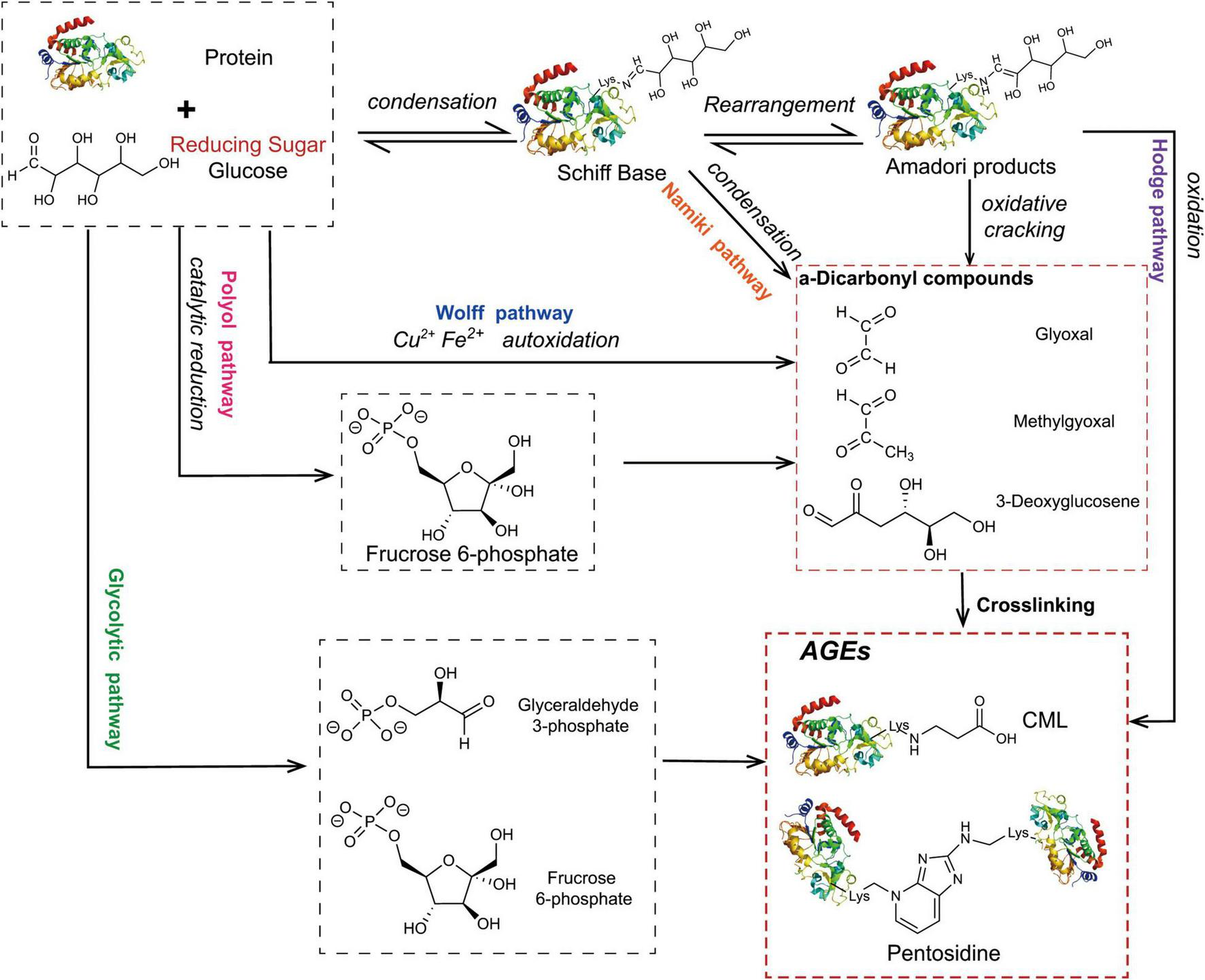
Glycation is a set of reactions in which sugars, or reactive molecules derived from them, attach to proteins or other biological molecules without an enzyme directing the attachment.
“Nonenzymatic” is the technical word for that last part. The reaction is different from glycosylation, a regulated process through which cells attach sugars to molecules for normal biological purposes. Similar-looking words describe different processes.
Some early glycation changes can proceed to more persistent structures called advanced glycation end products, or AGEs. This is a diverse group, not one molecule with one effect. Some AGEs create cross-links: chemical connections between parts of proteins.
Imagine adding extra ties to a fabric. The ties may change how easily it bends and how its fibers move relative to one another. The analogy is about altered material properties; skin is living tissue, so its maintenance and turnover also matter.
Why collagen is a subject of interest
Collagen in the extracellular matrix can remain in tissue for a long time. That gives chemical modifications an opportunity to accumulate.
One cross-link researchers have studied is glucosepane. In an analysis of human tissue, scientists measured several glycation-related cross-links in skin collagen and found that most increased with age. Some were present at higher levels in people with diabetes.
This supports a connection between long-term biological conditions and collagen chemistry. It does not show that a particular meal caused a visible skin change. The study analyzed tissue; it was not a trial in which people ate dessert and researchers counted new wrinkles.
That difference matters because a mechanism is often presented as if it were already a practical prediction. “This reaction can occur” and “this behavior will visibly age your face” are very different claims.
Blood glucose research is not a cosmetic diet rule
An ancillary study within the Diabetes Control and Complications Trial examined skin collagen in 216 people with type 1 diabetes. Long-term intensive treatment was associated with lower levels of several glycation-related measurements compared with conventional treatment.
This is important medical evidence about sustained glucose management in a defined population. It does not establish that people without diabetes should pursue unusually low glucose readings to improve their skin. It also does not replace an individualized diabetes care plan with cosmetic advice.
The timescale is part of the lesson: this research concerns long-term physiology, not a visible score assigned to yesterday's food choices.
If you have a condition affecting blood glucose, management belongs with your healthcare team. If you do not, a skin-aging claim alone is not a reason to start extreme restriction or interpret normal eating as damage.
Does “anti-glycation” mean existing cross-links are removed?
Not necessarily. A study might measure the prevention of a reaction, a decrease in one AGE marker, or a change in how cells process altered material. These are different endpoints.
In research on cultured human keratinocytes, investigators examined whether stimulating autophagy could reduce an AGE called carboxymethyl lysine, or CML, in the cells. Autophagy is a cellular process for breaking down and recycling selected material.
The plain-language question was whether cells could clear more of a particular altered substance under laboratory conditions. That does not demonstrate removal of established glucosepane cross-links from dermal collagen in a living person's face. The molecule, the location, and the model are different.
This is why “AGEs cannot ever be cleared” is too absolute, while “we can erase glycation” is too broad. Different modifications persist and are handled differently. A useful claim names the specific change it has actually measured.
Know what the study's measurement represents
| Research finding | A reasonable interpretation | A leap to avoid |
|---|---|---|
| More cross-links in older human tissue | Certain modifications accumulate with age | Every line on the face is caused by glycation |
| Lower markers after long-term diabetes treatment | Glucose management can influence tissue chemistry in that population | Everyone should minimize glucose for cosmetic reasons |
| Less CML in cultured cells | A tested process changed one cellular endpoint | Old dermal collagen cross-links were removed |
| A lower signal from a skin-measuring device | A measured signal changed | All AGEs, or visible wrinkles, changed by the same amount |
Researchers also use tools that measure skin autofluorescence—light emitted by certain substances in the skin after illumination. An early validation study compared these readings with measurements from skin biopsies. It is an indirect measure used in some settings, not a photograph of every AGE molecule. Glucosepane, CML, and a device reading should not be treated as interchangeable names for the same thing.
A more useful way to think about food and skin
You can care about long-term health without turning every meal into a skin calculation. A varied, adequate eating pattern serves many purposes; removing whole categories of food to prevent an imagined immediate wrinkle can make the decision much bigger than the evidence supports.
When a glycation claim makes you anxious, return to three details: what molecule was measured, in what kind of study, and over what period? Then ask whether the claimed benefit—fewer wrinkles, firmer skin, or altered collagen—was actually tested.
Glycation is real chemistry. The most useful response is proportionate to the evidence: understand the process, take relevant medical conditions seriously, and leave room for a normal life that includes food you enjoy.