“Regenerative” suggests more than a temporary improvement. It sounds as though skin is rebuilding itself, restoring something it has lost, perhaps even moving back toward an earlier state.
Sometimes researchers are studying exactly those kinds of questions. But the word alone does not tell you what changed, which layer was affected, or how convincing the evidence is.
The useful place to start is with a concrete outcome. Are we talking about more comfortable skin? Less water loss? A different arrangement of connective tissue? New, functional tissue replacing something that was missing? Each deserves its own explanation.
Skin already renews and repairs itself
Renewal describes the ongoing replacement of cells. In the epidermis, new cells arise and mature as they move toward the surface. This ordinary turnover is part of how skin maintains itself.
Repair describes a response to damage. Restoring a disrupted outer barrier is one example. A wound closing is another, although closed tissue does not necessarily have exactly the same structure as the tissue that was there before.
Remodeling involves changes to the organization and composition of tissue over time. In the dermis, that can include the balance of matrix production and breakdown.
Regeneration, used in a stricter biological sense, involves restoring lost tissue and its function. The distinction becomes easier to see when you compare the evidence required for each claim.
| Claim | The change it should identify | Evidence that would help evaluate it |
|---|---|---|
| Hydrates | More water in the outer layer | Controlled hydration measurements |
| Supports barrier recovery | Improved barrier function after disruption | Water-loss measurements over time and a suitable comparison |
| Changes dermal structure | A structural effect beneath the epidermis | Relevant imaging or tissue analysis, alongside meaningful outcomes |
| Regenerates tissue | Restoration of lost tissue and function | Direct evidence of the tissue restored, durability, and safety |
The last row asks more than a photograph of smoother-looking skin can answer.
A visible benefit does not identify its mechanism
Well-hydrated skin can look smoother. That does not make the result imaginary; it makes hydration a plausible explanation that needs to be distinguished from deeper structural change.
For example, a controlled study of hyaluronic-acid formulations measured improvements in hydration and elasticity, with some formulations also improving wrinkle-depth measurements. Those outcomes are useful. They do not, by themselves, show regeneration of the dermis.
Similarly, a barrier-repair study may use transepidermal water loss, or TEWL, to track how water escapes through skin. Research on physiological lipid mixtures used this approach to compare recovery after disruption. A better TEWL result is evidence about barrier function, not a direct measurement of new collagen.
Ask what the instrument measures before accepting a broader interpretation of what the skin has done.
What genuine regenerative research can look like
One striking human study published in 2017 treated a child with a severe genetic skin disorder using the child's own epidermal cells, genetically corrected and expanded outside the body before grafting. Researchers documented restoration of functional epidermis.
This was specialized medical treatment for a life-threatening condition. It is not a model for an everyday cosmetic routine, and its results cannot be borrowed to validate an unrelated topical claim. It is useful here because it shows how specific “regeneration” can be when researchers identify the tissue, intervention, function, and follow-up.
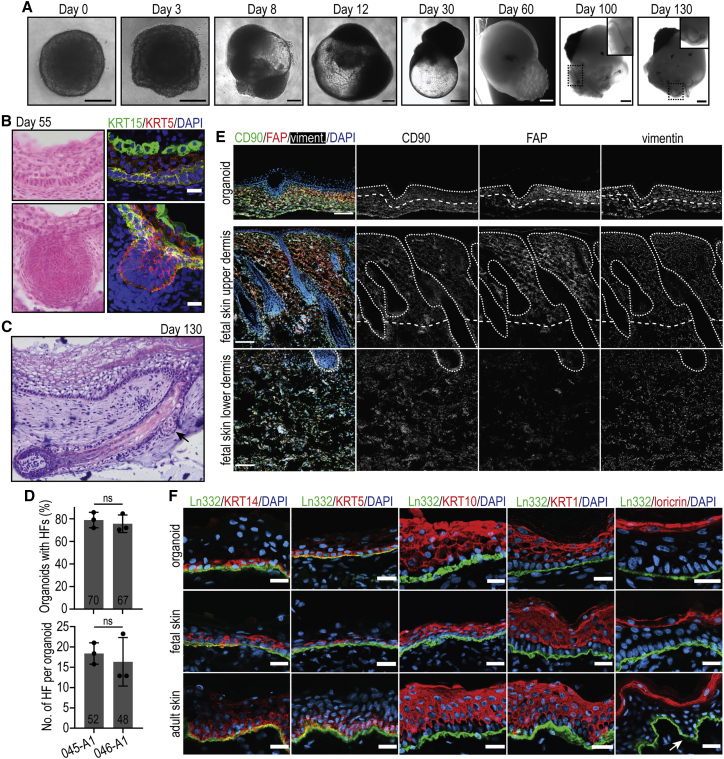
Another laboratory study generated hair-bearing skin from human pluripotent stem cells. Pluripotent means the cells can develop into many different cell types. Organoids are three-dimensional laboratory tissue models that reproduce selected features of an organ.
Such work advances our ability to model skin and investigate its development. Growing a skin model under carefully controlled conditions does not show that a topical application can produce the same architecture on a person's face.
“Cellular rejuvenation” needs an endpoint, too
You may also see research involving senescence, a state in which cells stop dividing and change their behavior. Scientists study markers associated with this state, but one marker cannot describe every aspect of a cell or a tissue.
In an exploratory human trial targeting mTOR signaling, researchers reported changes in a senescence-associated protein and a structural protein. The study was small and had substantial attrition. Such findings are a reason for further investigation, not proof that skin has been returned to a younger biological age.
There is an additional distinction between modifying a process and showing a durable benefit. If a marker changes during use, what happens afterward? Does the tissue function better? Is the improvement visible or meaningful? What are the longer-term effects? A compelling mechanism makes these questions more important, not unnecessary.
A patent and a biological explanation are pieces of the story
A patent can describe an invention and include experiments. It is not a substitute for examining the study design behind a particular efficacy claim.
The same is true of a sophisticated pathway diagram. It may accurately show how a signaling system works without demonstrating that a particular topical treatment reaches it, changes it in people, or delivers the claimed outcome.
When reading a “regenerative” claim, translate it into a sentence you could actually test: “This intervention improved this measurement, compared with this control, in these participants, over this period.” If those details are missing, the word is doing more work than the evidence you have been given.
Keep ordinary benefits in proportion
Comfortable skin, fewer flaky patches, or a modest improvement in fine lines can be worthwhile. They do not become less valuable because they fall short of tissue regeneration.
Across this series, the recurring idea is that skin contains several interacting systems. The outer barrier, dermal matrix, cells, chemical signals, and environment all contribute to how it functions. A change in one part can matter without proving that the entire system has been rebuilt.
The most useful skincare language makes the result easier to understand. When you hear “regenerative,” ask what was restored and how anyone knows. A precise answer gives you something to evaluate—and room to be interested without being swept along by the promise.