A new scientific word can make an ordinary skin concern feel more ominous. “Inflammaging” is a good example. If inflammation can contribute to aging, does a red patch mean your skin is suddenly losing ground? Should every occasional sting become an anti-aging emergency?
No useful assessment begins with that leap. The research asks how biological processes interact over time. It does not allow you to read the state of your collagen from a brief look in the mirror.
Inflammation is a response, not a single symptom
Inflammation is part of the body's response to injury, infection, and other stresses. It involves immune cells, changes in blood flow, and chemical messages that coordinate what happens next.
Those messages include cytokines, proteins that influence the behavior of other cells. You may see names such as interleukin-6, or IL-6, and interleukin-8, or IL-8, in research. They are specific signals measured in particular contexts, not substances you can diagnose by how warm your face feels.
An acute response can be part of normal protection and repair. The concern behind inflammaging is persistent, lower-level inflammatory activity associated with aging and tissue dysfunction. Duration, location, and context matter.
The everyday comparison is the difference between an alert that helps you respond to a problem and an alert that keeps sounding after circumstances have changed. Biology is less tidy, but the comparison explains why “reduce all inflammation” is too broad a goal.
Where cellular senescence enters the story
Cellular senescence is a state in which cells stop dividing and undergo other changes in behavior. A senescent cell can remain alive and metabolically active. It is not simply a dead cell waiting to be washed away.
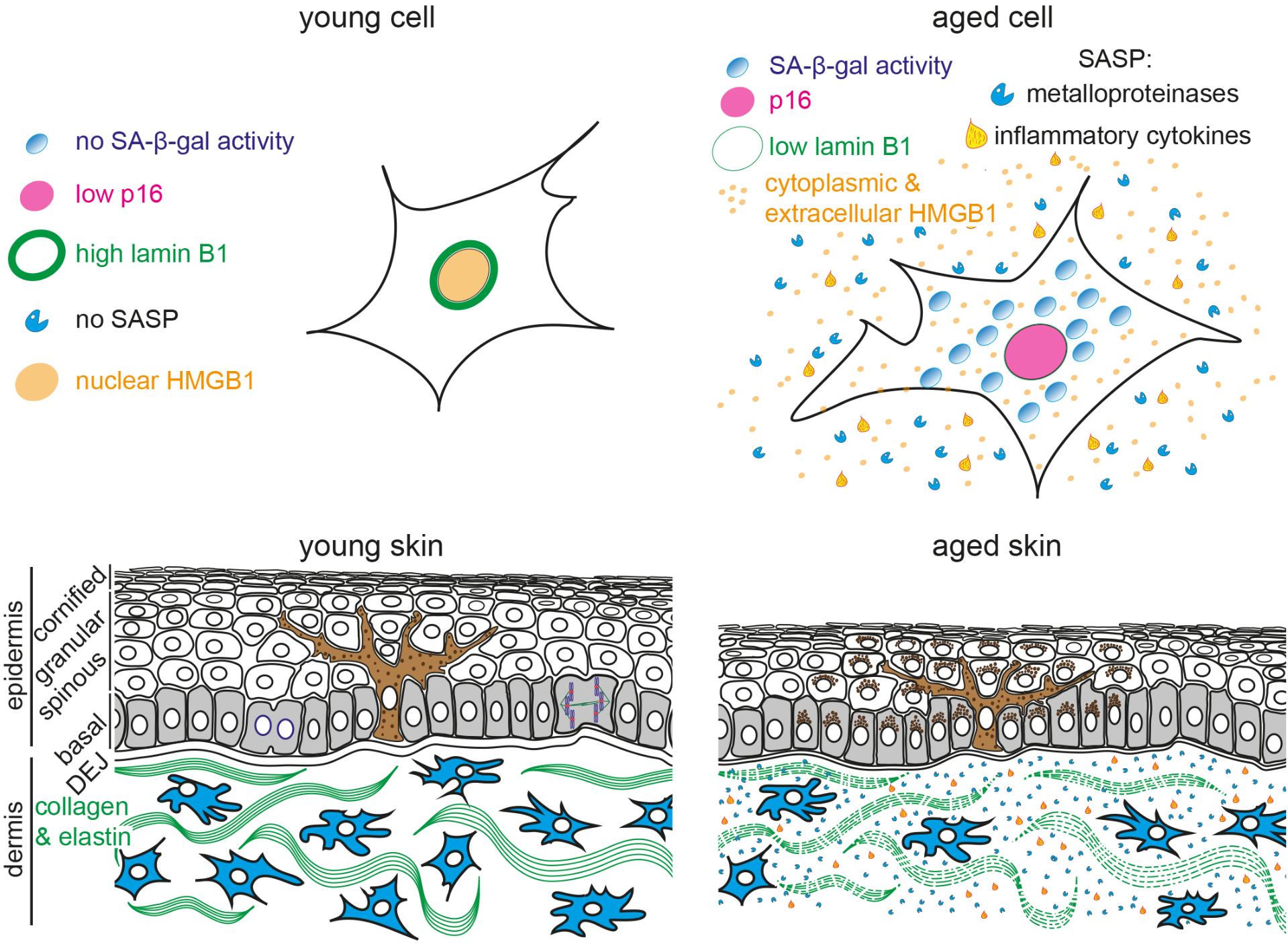
Some senescent cells release a mixture of signaling molecules called the senescence-associated secretory phenotype, or SASP. In plain language, a cell that has stopped dividing can still influence its neighbors through what it releases.
A foundational study of human cells characterized such secretions after cells were induced to become senescent. Many of the released factors were associated with inflammatory signaling. The work helped establish a way that a change within one cell could affect the surrounding tissue. It was mechanistic research, not a trial of a daily skincare routine.
This is also why “remove every old cell” is an oversimplification. Researchers need to distinguish cell states and understand their roles in the tissue, rather than assuming that a label tells the whole story.
What researchers have actually observed in skin
In a study comparing sun-exposed and protected skin, researchers examined samples from women across several decades of adulthood. They analyzed tissue structure, gene activity, proteins, and surface biomarkers. Some inflammatory and senescence-associated signals differed with age and exposure site.
The study supports investigating a connection between exposure, persistent signaling, and age-related skin changes. It cannot tell an individual reader that a particular flush, breakout, or dry patch is evidence of “inflammaging.” It also does not prove that reducing one measured marker will reverse visible aging.
A biomarker is a measurable indicator used to study a process. Think of it as one reading on an instrument panel. It can be informative without being a complete account of the system.
What this has to do with collagen
Skin maintenance involves both building and breaking down its structural materials. Matrix metalloproteinases, or MMPs, are enzymes involved in that breakdown and remodeling.
Researchers have observed increased MMP activity after controlled UV exposure in human skin. This offers one concrete connection between an environmental exposure, altered signaling, and collagen degradation.
It does not mean that any time skin looks irritated, a predictable amount of collagen is being lost. Nor does it establish that suppressing every remodeling enzyme would improve skin. Maintenance requires regulated activity, not a permanent stop order.
The practical lesson is to distinguish a studied pathway from a sweeping claim. A pathway explains how something may happen. A clinical study is needed to show whether a particular intervention changes an outcome in people.
Redness and sensitivity still deserve their own explanation
Persistent redness, burning, itching, or scaling can have several causes. Treating them as generic “early aging” can distract from identifying the actual problem.
| What you notice or read | What it can mean | What you cannot conclude from it alone |
|---|---|---|
| A flushed face | A visible change with several possible causes | A diagnosis of accelerated aging |
| Stinging after a new step | A reason to assess tolerability | Proof that the step is working |
| An elevated cytokine in a study | A measured signal in that study's setting | The same change in your skin |
| A lower senescence marker | An effect on one research endpoint | Complete rejuvenation of the tissue |
If a routine repeatedly makes your skin uncomfortable, adding more active steps to “fight inflammation” can make it harder to work out what is happening. A simpler record of timing, symptoms, and changes gives you—and, if needed, a dermatologist—something more concrete to assess.
The emerging research is not a home treatment plan
An exploratory human trial targeting the mTOR pathway reported changes in senescence-related and structural markers. mTOR is a signaling system involved in how cells respond to nutrients and growth signals. The study enrolled 36 people, with 19 discontinuing or lost to follow-up, so it warrants cautious interpretation.
That is a research direction, not a reason to self-prescribe a treatment or infer that everyday cosmetics do the same thing. The next questions include reproducibility, meaningful benefit, and safety with longer use.
For now, you can understand inflammaging without treating your face as a constant warning signal. Care for persistent symptoms, reduce avoidable irritation, and keep sun protection in view. Scientific understanding should make your choices clearer, not make every ordinary skin day feel like a test you are failing.